
Categories
Publications

Optimisation of 2D-LC separations by AutoLC

In their latest work, the AutoLC team of the CAST group of Pirok at the University of Amsterdam extended their method-development workflow to facilitate optimisation of 2D-LC separations [1].

The demonstrated workflow was capable of unsupervised gradient optimization for comprehensive 2D-LC-MS methods without needing to specify sample information. The required algorithms were designed by CAST researchers Stef Molenaar, Tijmen Bos and Jim Boelrijk, under the supervision of Bob Pirok.

The workflow was inspired by the original theoretical paper by Pirok in 2016 [2], in which retention models are constructed to computationally simulate methods and select the optimal parameters. In a nutshell, the system first utilizes very generic methods to measure the sample. This data is then used to construct retention models that describe the retention behavior of the analytes as a function of the mobile-phase composition. A large number of methods are then simulated computationally, and a computed optimum is submitted to the LC system. The LC system then carries out the proposed method and submits its data back to the system afterwards. Consequently, unsupervised optimisation of 2D-LC separations may be attained.
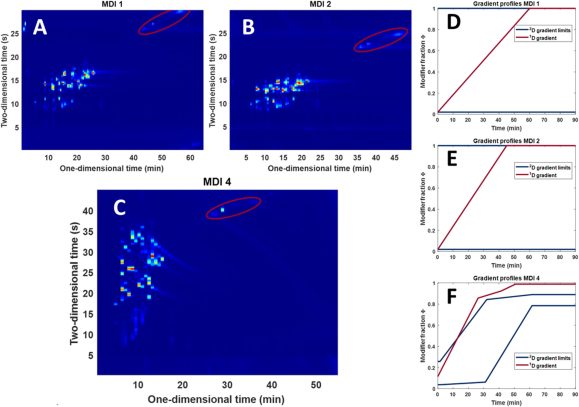
Unsupervised optimization of comprehensive 2D-LC separations
Figure 1. The AutoLC algorithm was demonstrated on a peptide digest separation using RPLC in both dimensions. Panels A, B, D and E show scanning conditions, with Panels C and F showing a computed method that was proposed unsupervised by the algorithm. Reproduced with permission from [1].

The Pirok group earlier had demonstrated their AutoLC platform on 1D separations [3], but now extended this to the more complicated 2D separation methods [1]. To accomplish this, algorithms were designed to compute and optimize complex second-dimension shifted-gradient assemblies.

The researchers also investigated the robustness of the retention models and the influence of the errors in peak-width predictions.

The study was conducted in a collaboration with the group of Dwight Stoll at Gustavus Adolphus College where the measurements were conducted. The developed tool for optimisation of 2D-LC separations was demonstrated on a complex peptide digest sample with RPLC in both of the dimensions.

The work was a product of Pirok’s UPSTAIRS (Unleashing the Potential of Separation Technology to Achieve Innovation in Research and Society) project, which is financed by the Dutch Research Council (NWO), as well as the synergetic UNMATCHED project, which is supported by BASF, DSM and Nouryon, and also receives funding from NWO.

The work was published open-access in Journal of Chromatography A and can be accessed free of charge here.

References

  1. Computer-driven optimization of complex gradients in comprehensive two-dimensional liquid chromatography, S.R.A. Molenaar, T.S. Bos, J. Boelrijk, T.A. Dahlseid, D.R. Stoll, B.W.J. Pirok, Chromatogr. A, 2023, 1707, 464396, DOI: 10.1016/j.chroma.2023.464306.
  2. Program for the interpretive optimization of two-dimensional resolution, B.W.J. Pirok, S. Pous-Torres, C. Ortiz-Bolsico, G. Vivó-Truyols and P.J. Schoenmakers, J. Chromatogr. A, 2016, 1450, 29–37, DOI: 10.1016/j.chroma.2016.04.061.
  3. Chemometric Strategies for Fully Automated Interpretive Method Development in Liquid Chromatography S. Bos, J. Boelrijk, S.R.A. Molenaar, B. van ‘t Veer, L.E. Niezen, D. van Herwerden, S. Samanipour, D.R. Stoll, P. Forré, B. Ensing, G.W. Somsen, B.W.J. Pirok, Anal. Chem. 2022, 94(46), 16060–16068, DOI: 10.1021/acs.analchem.2c03160.
Categories
Publications

2D-LC in industry: technological innovations reviewed

CAST scientist Rick van den Hurk wrote a review on recent developments in 2D-LC and the use of 2D-LC in industry. He did this under the supervision of Bob Pirok and in collaboration with Matthias Pursh (Dow) and Dwight Stoll (Gustavus Adolphus College).

Two-dimensional liquid chromatography (2D-LC) greatly advances the separation powered of analytical separation sciences through a better peak capacity as well as offering more-tailored selectivity combinations.

However, the field of 2D-LC is, in particular in contrast to 2D-GC, still very immature and under significant development. In 2019, Bob Pirok, Dwight Stoll and Peter Schoenmakers published a review in which they examined the latest trends from 2015 until 2019 [1].

In this recent installment [2], Rick van den Hurk reviewed the recent innovations between 2019 and 2023. In addition the review also devotes significant focus to the implementation of the technique in industry. The review was co-written by Bob Pirok, Dwight Stoll (Gustavus Adolphus College) and Matthias Pursch (Dow).

The authors examined over 200 articles and also compared these with the articles published prior to 2019. In their review, the authors concluded that mobile-phase mismatch continues to be an important focus area for the field, and several modulation strategies and new variants were discussed.

Van den Hurk and co-workers also noticed that a third of the publications had at least one author affiliated with industry. Application fields that particularly demonstrated involvement were the polymer characterization, metabolomics, and pharmaceutical and biopharmaceutical analysis. Furthermore, industrial applications favored the use of heart-cut 2D-LC and largely employed on-line hyphenation. The authors did note that the database was likely to be missing out on a number of industrial works that are not published for confidentiality reasons.

Other important developments were the increased popularity of computer-aided strategies, alternative gradient-elution methods to facilitate modulation, as well as multi-stage, multi-dimensional separations, the latter of which were applied to the characterization of protein therapeutics.

2D-LC in industry: technological innovations reviewed
Figure. Number of applications per application area distributed by non-comprehensive (light blue) and comprehensive (dark blue) applications between 2019 and 2023. Reproduced with permission from [2].

Two-dimensional liquid chromatography is of paramount importance to the PARADISE project of CAST scientist Bob Pirok in which multi-dimensional separation technology is used to achieve separation of highly complex samples. In addition, the project aims to characterize the correlation of different sample properties within a single analytical solution. The outcomes of this recent review are thus of value to the ongoing progress in the PARADISE project. Rick van den Hurk is a PhD candidate in the PARADISE project, which stands for Propelling Analysts by Removing Analytical-, Data-, Instrument- and Sample-related Encumbrances and receives funding from the Dutch Research Council (NWO), as well as a number of public and private organisations. Read more about the PARADISE project here.

In addition, the review was part of Pirok’s UPSTAIRS project, which aims to improve the accessibility of advanced separation technology by developing computational methods to leverage chromatographic theory in an unsupervised workflow. This project also receives funding from NWO.

The work was published in TrAC Trends in Analytical Chemistry as open access, and can thus be accessed for free here.

References

  1. Recent Developments in Two-Dimensional Liquid Chromatography: Fundamental Improvements for Practical Applications, B.W.J. Pirok, D.R. Stoll and P.J. Schoenmakers, Anal. Chem., 2019, 91(1), 240-263, DOI: 10.1021/acs.analchem.8b04841
  2. Recent trends in two-dimensional liquid chromatography, R.S. van den Hurk, M. Pursch, D.R. Stoll, B.W.J. Pirok, TrAC Trends in Analytical Chemistry, 2023, 166, 117166, DOI: 1016/j.trac.2023.117166
Categories
Publications

Unsupervised LC method development with AutoLC

In an international and interdisciplinary collaboration, CAST members Tijmen Bos, Stef Molenaar, Jim Boelrijk, Leon Niezen and Bob Pirok have demonstrated unsupervised LC method development with AutoLC. This is the first automated LC-MS method development workflow. It was applied it to a complex antibody digest sample. The work was recently published in Analytical Chemistry as cover article [1].

The majority of liquid chromatography (LC) methods are still developed in a conventional manner, that is, by analysts who rely on their knowledge and experience to make method development decisions. To tackle this problem, several tools utilizing design-of-experiment workflows, retention modeling based on experimental data and/or chemical structure information have been developed and even commercialized.

However, these approaches are generally difficult to scale with sample complexity and require significant user input to operate. Consequently, high-resolution separation technology and multi-dimensional systems have not been economically feasible for routine use. To improve the accessibility of state-of-the-art separation technology, the Pirok group at the University of Amsterdam is developing a workflow capable of unsupervised method development.

This has led to the present demonstration of a novel, open-source algorithm for automated and interpretive method development of LC(−mass spectrometry) separations (“AutoLC”). The scientists constructed a closed-loop workflow that interacted directly with the LC system and ran unsupervised in an automated fashion. 

The first demonstration of AutoLC was published as front cover article in Analytical Chemistry
The study was published as feature article in Analytical Chemistry.
Unsupervised LC method development with AutoLC
Schematic overview of the generic workflow employed by the AutoLC algorithm using retention modeling (top, blue) or BO (bottom, pink).

The team tested the algorithm using two newly designed method development strategies. The first utilized retention modeling, whereas the second used a Bayesian-optimization machine learning approach. In both cases, the algorithm could arrive within 4–10 iterations (i.e., sets of method parameters) at an optimum of the objective function, which included resolution and analysis time as measures of performance.

Retention modeling was found to be more efficient while depending on peak tracking, whereas Bayesian optimization was more flexible but limited in scalability. We have deliberately designed the algorithm to be modular to facilitate compatibility with previous and future work (e.g., previously published data handling algorithms).

AutoLC was tested on a peptide digest mixture.
The AutoLC framework was tested on an antibody digest sample. A) example of a generic scouting measurement, B) proposed optimum at the 4th iteration. Reproduced with permission of [1].

The degree of separation is often quantified as the resolution between chromatographic peaks, which can be written as a product of retention, selectivity and chromatographic efficiency. Currently, the AutoLC framework largely focuses on retention, but contemporary efforts have shifted focus to include selectivity. Support of validation is the logical next step thereafter.

AutoLC leverages earlier studies and interdisciplinary expertise

The AutoLC framework is the product of a several years of scientific studies that were conducted within public-private partnerships by the group of Pirok. These projects focused relevant aspects such as peak tracking [2,3], machine learning [4], and gradient deformation [5]. The AutoLC framework was designed to be modular so as to leverage global initiatives by the scientific community that were published in literature. Currently, the development of the framework is supported by funding from several grants from the Dutch Research Council (NWO). It is the prime topic of the UPSTAIRS project.

The present study was conducted in collaboration with Dr. Bernd Ensing (Computational Chemistry, University of Amsterdam), Dr. Saer Samanipour (Analytical Chemistry, University of Amsterdam), Dr. Patrick Forré (Institute for Informatics, University of Amsterdam), as well as scientists from Gustavus Adolphus College.

Special acknowledgement to Peter Schoenmakers

In the article, the authors acknowledged Prof. Peter Schoenmakers for his founding contributions. In one of his first papers in 1978 on gradient selection for RPLC method development Schoenmakers already envisaged the use of scouting data to facilitate automated method development [6].

Schoenmakers was the promotor of Bob Pirok, who first published about this topic in his 2016 paper in which the theoretical possibility of leveraging these concepts for 2D-LC were investigated [7]. This study was marked the start of this research line that, ultimately, led to the present publication of AutoLC.

References

  1. Chemometric Strategies for Fully Automated Interpretive Method Development in Liquid Chromatography S. Bos, J. Boelrijk, S.R.A. Molenaar, B. van ‘t Veer, L.E. Niezen, D. van Herwerden, S. Samanipour, D.R. Stoll, P. Forré, B. Ensing, G.W. Somsen, B.W.J. Pirok, Anal. Chem. 2022, 94(46), 16060–16068, DOI: 10.1021/acs.analchem.2c03160.
  2. Peak-Tracking Algorithm for Use in Automated Interpretive Method-Development Tools in Liquid Chromatography, B.W.J. Pirok, S.R.A. Molenaar, L.S. Roca and P.J. Schoenmakers, Anal. Chem., 2018, 90(23), 14011-14019, DOI: 10.1021/acs.analchem.8b03929.
  3. Peak-tracking algorithm for use in comprehensive two-dimensional liquid chromatography – application to monoclonal antibody peptides, R.A. Molenaar, T.A. Dahlseid, G. Leme, D.R. Stoll, P.J. Schoenmakers, B.W.J. Pirok, J. Chromatogr. A, 2021, 1639, 461922, DOI: 10.1016/j.chroma.2021.461922.
  4. Bayesian Optimization of Comprehensive Two-dimensional Liquid Chromatography Separations, J. Boelrijk, B.W.J. Pirok, B. Ensing, P. Forré, Chromatogr. A, 1659, 2021, 462628, DOI: 10.1016/j.chroma.2021.462628.
  5. Reducing the influence of geometry-induced gradient deformation in liquid chromatographic retention modellingS. Bos, L.E. Niezen, M.J. den Uijl, S.R.A. Molenaar, S. Lege, P.J. Schoenmakers, G.W. Somsen, B.W.J. Pirok, J. Chromatogr. A, 2021, 1635, 461714, DOI: 10.1016/j.chroma.2020.461714.
  6. Gradient selection in reversed-phase liquid chromatography, P.J. Schoenmakers, H.A.H. Billiet, R. Tussen, L. De Galan, J. Chromatogr. A, 1978, 149,  519-537, DOI: 10.1016/S0021-9673(00)81008-0.
  7. Program for the interpretive optimization of two-dimensional resolution, B.W.J. Pirok, S. Pous-Torres, C. Ortiz-Bolsico, G. Vivó-Truyols and P.J. Schoenmakers, J. Chromatogr. A, 2016, 1450, 29–37, DOI: 10.1016/j.chroma.2016.04.061.
Categories
Publications

Use and Limits of Scouting Experiments for Retention Modelling

Retention modelling is a useful technique which can be used to substantially reduce the method-development process for LC separations [1]. Believe it or not, as complicated and distant it may seem from routine use in the analytical, it actually is useful to make life easier.

Retention modelling saves us a lot of time

One branch of retention modelling in liquid chromatography employs scouting (or ‘scanning’) experiments to probe retention of analytes of interest. By fitting models to the recorded retention times, retention parameters are obtained for each individual analyte. Interestingly, this information can be used to predict retention times for the analytes under conditions different from those used for the scouting experiments. 

In other words, a computer can use these to simulate large numbers of hypothetical separation methods. By analyzing the resulting separations, optimal method parameters can be discerned. As a consequence, trial-and-error method development can be replaced by a number of scouting experiments and thus saves valuable time.

Figure 1. Workflow of the method optimization using scanning gradients to obtain retention-model parameters. The workflow starts at the top right with an insufficiently-resolved sample, on which scouting experiments are performed to yield retention parameters. These can be used to compute the most-optimal method parameters, thus saving a lot of valuable method-development time. Reproduced with permission from [2].

We have earlier explained why, ideally, we would like to use gradient elution during these scanning experiments, something also shown by Vivo-Truyóls et al. [3]. In contrast to isocratic elution, gradients are more practical and save a lot of time at the cost of significantly more challenging modelling and less accurate retention parameters.

With the entire method-development automatization approach hinging on the accuracy of retention parameters, it is imperative that usefulness of the gradient experiments is mapped and, if possible, improved.

Optimizing the separation of unknown degradation products

CAST member and PhD candidate Mimi den Uijl develops analytical methods based on 2D-LC to degrade and characterize small molecules and their degradation products. Under the lead of Prof. Maarten van Bommel, her application area ranges from cultural-heritage art objects, to environmental aqueous samples, to foodstuffs (Unilever). While the identify of the parent molecules are sometimes known, this is certainly not the case for degradation products. Yet optimized methods are needed to characterize such samples.

Den Uijl and co-workers participated in a large collaboration between the teams of Bob Pirok (University of Amsterdam) and Dwight Stoll (Gustavus Adolphus College), and – in their project – systematically investigated the use and limits of gradient experiments for method-development workflows.

Figure 2. Combined results of all investigated factors. The box-and-whisker plots represent the average prediction error of all the compounds for a noisy dataset (top) and highly-precise (bottom) dataset. See publication for more details. Reproduced with permission from [2].

For the first stage published in Journal of Chromatography A, two datasets were generated of various small molecules ranging in chemical properties [2]. One dataset was measured was recorded with very high measurement prevision relative to the other. Interestingly, some of the results were different between the two sets.

Several key observations

These and other conclusions are detailed in the article which was published in Journal of Chromatography A as open-access article. This means you can download and read it for free. Meanwhile, we decided to continue this project, so we hope to be able to report more about this at a later stage.

References

[1] Recent applications of retention modelling in liquid chromatography, M.J. den Uijl,  P.J. Schoenmakers,  B.W.J. Pirok, and  M.R. van Bommel, J. Sep. Sci.2020, DOI: 10.1002/jssc.202000905.

[2] Measuring and using scanning-gradient data for use in method optimization for liquid chromatography, Mimi J. den Uijl, Peter J. Schoenmakers, Grace K. Schulte, Dwight R. Stoll, Maarten R. van Bommel, Bob W.J. Pirok, J. Chromatogr. A, 2021, 1636, 461780, DOI: 10.1016/j.chroma.2020.461780

[3] Error analysis and performance of different retention models in the transference of data from/to isocratic/gradient elution, Author links open overlay panel, G. Vivó-Truyols, J.R. Torres-Lapasió, M.C. García-Alvarez-Coque, J. Chromatogr. A, 2003, 1018(2), 169-181, DOI: 10.1016/j.chroma.2003.08.044.

[4] Reducing the influence of geometry-induced gradient deformation in liquid chromatographic retention modelling, T.S. Bos, L.E. Niezen, M.J. den Uijl, S.R.A. Molenaar, S. Lege, P.J. Schoenmakers, G.W. Somsen, B.W.J. Pirok, J. Chromatogr. A2020, 1635, 461714, DOI: 10.1016/j.chroma.2020.461714.

Mimi den Uijl was a PhD student in the TooCOLD (Toolbox for studying the Chemistry Of Light-induced Degradation) project at the University of Amsterdam. In this project, Mimi developed light-induced reaction modulators for use in 2D-LC. She defended her PhD in 2022.