Categories
Publications

Educational textbook Analytical Separation Science launched by Pirok and Schoenmakers

At the renowned HPLC2025 conference, a milestone in the field of separation science was celebrated with the official launch of Analytical Separation Science, a comprehensive new textbook authored by Dr. Bob Pirok and Prof. Peter Schoenmakers. The launch event, held on June 16 at the Historium Bruges and organized by the Royal Society of Chemistry (RSC), brought together leading scientists and educators in the field.

The first official copy was presented to Prof. Govert Somsen of the Vrije Universiteit Amsterdam, a long-time colleague and co-educator in analytical chemistry.

Structured around Basic, Master, and Advanced modules, the book serves both as a teaching tool and as a professional reference. It introduces fundamental concepts, offers in-depth treatments for graduate-level study, and explores cutting-edge developments in chromatographic and electrophoretic techniques.

This book reflects our shared commitment to educating the next generation of analytical scientists,” said Prof. Peter Schoenmakers. “By combining foundational theory with real-world case studies and emerging methods, we aim to make separation science engaging and relevant across career stages.

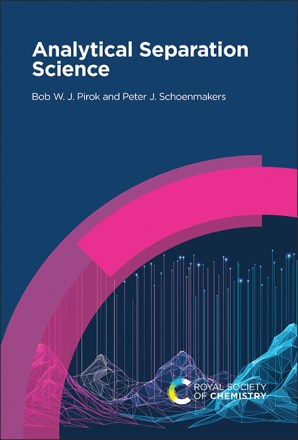
Figure 1. Cover of the book.

An interactive companion website (https://ass-ets.org) extends the book’s reach. It offers additional resources including a literature repository, academic lectures with interactive figures, and exercises based on decades of teaching experience at the University of Amsterdam and Vrije Universiteit Amsterdam.

The website is a community based effort with universities to be supporting their expertise to complete the analytical portfolio as much as possible.

Figure 2. Prof. Wolfgang Lindner (University of Vienna) and Prof. Peter Schoenmakers (University of Amsterdam) draw the winners of the book competition.

Our goal was to make learning separation science both accessible and inspiring,” added Dr. Bob Pirok. “This project combines our classroom experience with insights from industry collaborations, bridging education and practice.”

Figure 3. Photograph from the launch event.

Conference participants were able to win a copy of the book by solving a series of puzzles and Prof. Wolfgang Lindner (University of Vienna) and Prof. Schoenmakers (University of Amsterdam) drew the five winners from the entries.

The book is now available at the Royal Society of Chemistry or any other book vendor.

Categories
Publications

NPLC method to characterize end groups of poly lactic acid co-glycolic acid copolymers

The CAST scientist Masashi Serizawa recently published a manuscript in which he investigated a novel method of using gradient elution normal-phase liquid chromatography with basic and acidic additives to separate PLGAs in the different end groups and in the different chemical compositions at the same time.

PLGA is an important material in drug delivery systems. It is used in nanoparticle-containing drugs to prevent a sudden increase in drug concentration in the body when the drug is ingested. The LA/GA ratio and differences in the terminal structure of PLGA have a significant effect on the degradation rate of PLGA in the body.

To distinguish these distinctions, we created a unique ternary gradient liquid chromatography method utilizing base and acid additives. Initially, we used a gradient of hexane, a poor solvent, and ethyl acetate, a good solvent, with a mobile phase containing a base additive to separate non-ester-terminated PLGAs (ester-terminated PLGA and cyclic PLGA) based on their chemical composition. Subsequently, by switching the mobile phase to THF containing an acid additive, we were able to elute acid-terminated PLGA.

This method offers the advantage of quick analysis compared to traditional NMR methods, making it potentially valuable for future industrial research. Furthermore, it can be applied to high molecular weight PLGA of 180 kDa, making it useful for the development of high molecular weight PLGA, which is challenging to analyze using mass spectrometry techniques such as MALDI-TOF-MS.


Figure: (left) schematic illustration of the working principle of the NPLC separation. (right): key results obtained in the study


The study is supported by the COAST/ TKI-Chemistry POLY-SEQU-ENCHY project between the UvA and Corbion (Gorinchem, The Netherlands) and is funded by Mitsubishi Chemical Corporation.

The link to the publication is reported below.

https://doi.org/10.1016/j.chroma.2024.465137

Categories
Publications

Unsupervised LC method development with AutoLC

In an international and interdisciplinary collaboration, CAST members Tijmen Bos, Stef Molenaar, Jim Boelrijk, Leon Niezen and Bob Pirok have demonstrated unsupervised LC method development with AutoLC. This is the first automated LC-MS method development workflow. It was applied it to a complex antibody digest sample. The work was recently published in Analytical Chemistry as cover article [1].

The majority of liquid chromatography (LC) methods are still developed in a conventional manner, that is, by analysts who rely on their knowledge and experience to make method development decisions. To tackle this problem, several tools utilizing design-of-experiment workflows, retention modeling based on experimental data and/or chemical structure information have been developed and even commercialized.

However, these approaches are generally difficult to scale with sample complexity and require significant user input to operate. Consequently, high-resolution separation technology and multi-dimensional systems have not been economically feasible for routine use. To improve the accessibility of state-of-the-art separation technology, the Pirok group at the University of Amsterdam is developing a workflow capable of unsupervised method development.

This has led to the present demonstration of a novel, open-source algorithm for automated and interpretive method development of LC(−mass spectrometry) separations (“AutoLC”). The scientists constructed a closed-loop workflow that interacted directly with the LC system and ran unsupervised in an automated fashion. 

The first demonstration of AutoLC was published as front cover article in Analytical Chemistry
The study was published as feature article in Analytical Chemistry.
Unsupervised LC method development with AutoLC
Schematic overview of the generic workflow employed by the AutoLC algorithm using retention modeling (top, blue) or BO (bottom, pink).

The team tested the algorithm using two newly designed method development strategies. The first utilized retention modeling, whereas the second used a Bayesian-optimization machine learning approach. In both cases, the algorithm could arrive within 4–10 iterations (i.e., sets of method parameters) at an optimum of the objective function, which included resolution and analysis time as measures of performance.

Retention modeling was found to be more efficient while depending on peak tracking, whereas Bayesian optimization was more flexible but limited in scalability. We have deliberately designed the algorithm to be modular to facilitate compatibility with previous and future work (e.g., previously published data handling algorithms).

AutoLC was tested on a peptide digest mixture.
The AutoLC framework was tested on an antibody digest sample. A) example of a generic scouting measurement, B) proposed optimum at the 4th iteration. Reproduced with permission of [1].

The degree of separation is often quantified as the resolution between chromatographic peaks, which can be written as a product of retention, selectivity and chromatographic efficiency. Currently, the AutoLC framework largely focuses on retention, but contemporary efforts have shifted focus to include selectivity. Support of validation is the logical next step thereafter.

AutoLC leverages earlier studies and interdisciplinary expertise

The AutoLC framework is the product of a several years of scientific studies that were conducted within public-private partnerships by the group of Pirok. These projects focused relevant aspects such as peak tracking [2,3], machine learning [4], and gradient deformation [5]. The AutoLC framework was designed to be modular so as to leverage global initiatives by the scientific community that were published in literature. Currently, the development of the framework is supported by funding from several grants from the Dutch Research Council (NWO). It is the prime topic of the UPSTAIRS project.

The present study was conducted in collaboration with Dr. Bernd Ensing (Computational Chemistry, University of Amsterdam), Dr. Saer Samanipour (Analytical Chemistry, University of Amsterdam), Dr. Patrick Forré (Institute for Informatics, University of Amsterdam), as well as scientists from Gustavus Adolphus College.

Special acknowledgement to Peter Schoenmakers

In the article, the authors acknowledged Prof. Peter Schoenmakers for his founding contributions. In one of his first papers in 1978 on gradient selection for RPLC method development Schoenmakers already envisaged the use of scouting data to facilitate automated method development [6].

Schoenmakers was the promotor of Bob Pirok, who first published about this topic in his 2016 paper in which the theoretical possibility of leveraging these concepts for 2D-LC were investigated [7]. This study was marked the start of this research line that, ultimately, led to the present publication of AutoLC.

References

  1. Chemometric Strategies for Fully Automated Interpretive Method Development in Liquid Chromatography S. Bos, J. Boelrijk, S.R.A. Molenaar, B. van ‘t Veer, L.E. Niezen, D. van Herwerden, S. Samanipour, D.R. Stoll, P. Forré, B. Ensing, G.W. Somsen, B.W.J. Pirok, Anal. Chem. 2022, 94(46), 16060–16068, DOI: 10.1021/acs.analchem.2c03160.
  2. Peak-Tracking Algorithm for Use in Automated Interpretive Method-Development Tools in Liquid Chromatography, B.W.J. Pirok, S.R.A. Molenaar, L.S. Roca and P.J. Schoenmakers, Anal. Chem., 2018, 90(23), 14011-14019, DOI: 10.1021/acs.analchem.8b03929.
  3. Peak-tracking algorithm for use in comprehensive two-dimensional liquid chromatography – application to monoclonal antibody peptides, R.A. Molenaar, T.A. Dahlseid, G. Leme, D.R. Stoll, P.J. Schoenmakers, B.W.J. Pirok, J. Chromatogr. A, 2021, 1639, 461922, DOI: 10.1016/j.chroma.2021.461922.
  4. Bayesian Optimization of Comprehensive Two-dimensional Liquid Chromatography Separations, J. Boelrijk, B.W.J. Pirok, B. Ensing, P. Forré, Chromatogr. A, 1659, 2021, 462628, DOI: 10.1016/j.chroma.2021.462628.
  5. Reducing the influence of geometry-induced gradient deformation in liquid chromatographic retention modellingS. Bos, L.E. Niezen, M.J. den Uijl, S.R.A. Molenaar, S. Lege, P.J. Schoenmakers, G.W. Somsen, B.W.J. Pirok, J. Chromatogr. A, 2021, 1635, 461714, DOI: 10.1016/j.chroma.2020.461714.
  6. Gradient selection in reversed-phase liquid chromatography, P.J. Schoenmakers, H.A.H. Billiet, R. Tussen, L. De Galan, J. Chromatogr. A, 1978, 149,  519-537, DOI: 10.1016/S0021-9673(00)81008-0.
  7. Program for the interpretive optimization of two-dimensional resolution, B.W.J. Pirok, S. Pous-Torres, C. Ortiz-Bolsico, G. Vivó-Truyols and P.J. Schoenmakers, J. Chromatogr. A, 2016, 1450, 29–37, DOI: 10.1016/j.chroma.2016.04.061.