Categories
Publications

NPLC method to characterize end groups of poly lactic acid co-glycolic acid copolymers

The CAST scientist Masashi Serizawa recently published a manuscript in which he investigated a novel method of using gradient elution normal-phase liquid chromatography with basic and acidic additives to separate PLGAs in the different end groups and in the different chemical compositions at the same time.

PLGA is an important material in drug delivery systems. It is used in nanoparticle-containing drugs to prevent a sudden increase in drug concentration in the body when the drug is ingested. The LA/GA ratio and differences in the terminal structure of PLGA have a significant effect on the degradation rate of PLGA in the body.

To distinguish these distinctions, we created a unique ternary gradient liquid chromatography method utilizing base and acid additives. Initially, we used a gradient of hexane, a poor solvent, and ethyl acetate, a good solvent, with a mobile phase containing a base additive to separate non-ester-terminated PLGAs (ester-terminated PLGA and cyclic PLGA) based on their chemical composition. Subsequently, by switching the mobile phase to THF containing an acid additive, we were able to elute acid-terminated PLGA.

This method offers the advantage of quick analysis compared to traditional NMR methods, making it potentially valuable for future industrial research. Furthermore, it can be applied to high molecular weight PLGA of 180 kDa, making it useful for the development of high molecular weight PLGA, which is challenging to analyze using mass spectrometry techniques such as MALDI-TOF-MS.


Figure: (left) schematic illustration of the working principle of the NPLC separation. (right): key results obtained in the study


The study is supported by the COAST/ TKI-Chemistry POLY-SEQU-ENCHY project between the UvA and Corbion (Gorinchem, The Netherlands) and is funded by Mitsubishi Chemical Corporation.

The link to the publication is reported below.

https://doi.org/10.1016/j.chroma.2024.465137

Categories
Publications

Optimisation of 2D-LC separations by AutoLC

In their latest work, the AutoLC team of the CAST group of Pirok at the University of Amsterdam extended their method-development workflow to facilitate optimisation of 2D-LC separations [1].

The demonstrated workflow was capable of unsupervised gradient optimization for comprehensive 2D-LC-MS methods without needing to specify sample information. The required algorithms were designed by CAST researchers Stef Molenaar, Tijmen Bos and Jim Boelrijk, under the supervision of Bob Pirok.

The workflow was inspired by the original theoretical paper by Pirok in 2016 [2], in which retention models are constructed to computationally simulate methods and select the optimal parameters. In a nutshell, the system first utilizes very generic methods to measure the sample. This data is then used to construct retention models that describe the retention behavior of the analytes as a function of the mobile-phase composition. A large number of methods are then simulated computationally, and a computed optimum is submitted to the LC system. The LC system then carries out the proposed method and submits its data back to the system afterwards. Consequently, unsupervised optimisation of 2D-LC separations may be attained.

Unsupervised optimization of comprehensive 2D-LC separations
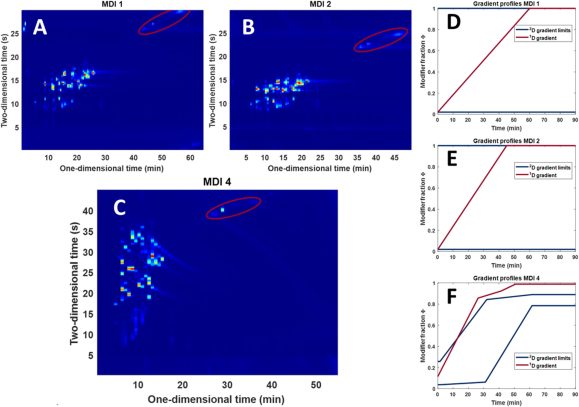
Figure 1. The AutoLC algorithm was demonstrated on a peptide digest separation using RPLC in both dimensions. Panels A, B, D and E show scanning conditions, with Panels C and F showing a computed method that was proposed unsupervised by the algorithm. Reproduced with permission from [1].

The Pirok group earlier had demonstrated their AutoLC platform on 1D separations [3], but now extended this to the more complicated 2D separation methods [1]. To accomplish this, algorithms were designed to compute and optimize complex second-dimension shifted-gradient assemblies.

The researchers also investigated the robustness of the retention models and the influence of the errors in peak-width predictions.

The study was conducted in a collaboration with the group of Dwight Stoll at Gustavus Adolphus College where the measurements were conducted. The developed tool for optimisation of 2D-LC separations was demonstrated on a complex peptide digest sample with RPLC in both of the dimensions.

The work was a product of Pirok’s UPSTAIRS (Unleashing the Potential of Separation Technology to Achieve Innovation in Research and Society) project, which is financed by the Dutch Research Council (NWO), as well as the synergetic UNMATCHED project, which is supported by BASF, DSM and Nouryon, and also receives funding from NWO.

The work was published open-access in Journal of Chromatography A and can be accessed free of charge here.

References

  1. Computer-driven optimization of complex gradients in comprehensive two-dimensional liquid chromatography, S.R.A. Molenaar, T.S. Bos, J. Boelrijk, T.A. Dahlseid, D.R. Stoll, B.W.J. Pirok, Chromatogr. A, 2023, 1707, 464396, DOI: 10.1016/j.chroma.2023.464306.
  2. Program for the interpretive optimization of two-dimensional resolution, B.W.J. Pirok, S. Pous-Torres, C. Ortiz-Bolsico, G. Vivó-Truyols and P.J. Schoenmakers, J. Chromatogr. A, 2016, 1450, 29–37, DOI: 10.1016/j.chroma.2016.04.061.
  3. Chemometric Strategies for Fully Automated Interpretive Method Development in Liquid Chromatography S. Bos, J. Boelrijk, S.R.A. Molenaar, B. van ‘t Veer, L.E. Niezen, D. van Herwerden, S. Samanipour, D.R. Stoll, P. Forré, B. Ensing, G.W. Somsen, B.W.J. Pirok, Anal. Chem. 2022, 94(46), 16060–16068, DOI: 10.1021/acs.analchem.2c03160.
Categories
Publications

Simulated Impact of Machine Learning on 2D-LC Optimization

The prospect of simplified method development for 1D and 2D-LC separations has long been sought for. Indeed, past CAST publications, but also those by many other groups, have investigated the classical approach used also extensively for 1D separations using empirical retention models. Meanwhile, machine-learning tools have emerged as an alternative across STEM fields. It is thus not surprising that its application has been of interest to several groups in the chromatographic community.

Together with dr. Patrick Forré from the Institute of Informatics at the University of Amsterdam, as well as researchers from the Van ‘t Hoff Institute for Molecular Sciences dr. Bernd Ensing (Computational Chemistry) and CAST member dr. Bob Pirok (Analytical Chemistry), PhD candidate Jim Boelrijk (Institute of Informatics) studied the feasibility of using Bayesian Optimization for the optimization of method development in 2D-LC separations.

For any machine learning tool to operate effectively within the context of method optimization, the use of a chromatographic response function or objective function is of paramount importance. Such functions quantify a particular quality descriptor that represent the performance of the separation method. Known examples in the field of 2D separations are peak capacity and orthogonality. However, maximised peak capacity or orthogonality does not necessarily translate into a high information yield. Resolution has also been investigated but its use is impaired by scaling issues. Consequently, the present study employed the concept of connected components (Figure 1). 

Figure 1. Example of labelling of a chromatogram by the chromatographic response function. Blue dots denote components separated with resolutions higher than 1 from all other peaks; red dots denote peaks that are within proximity to neighbors and are clustered together, illustrated by the red lines.

The simulated method development cycles yielded a larger number of separated peaks clusters (connected components) relative to the random and grid search algorithms (Figure 2).

Figure 2. Comparison of the random search, grid search and Bayesian optimization algorithm for sample A (top-left), B (top-right), C (bottom-left) and D (bottom-right) for 100 trials. The vertical black dashed line shows the maximum observed in the grid search (out of 11,664 experiments), while the blue and orange bars denote the best score out 104 iterations for the random search and Bayesian optimization algorithm, respectively.

The study by Boelrijk demonstrated that Bayesian optimization is a viable method for optimization of chromatographic experiments with many method parameters, and therefore also for direct experimental optimization of simple to moderate separation problems. This study was conducted under a simplified chromatographic reality (Gaussian peaks and equal concentration of analytes, generated compounds). Boelrijk thus remains interested to continue this research by working towards actual direct experimental optimization.