Categories
Publications

SEC-MS and Enzymes for polyester polymers analysis

CAST scientist Masashi Serizawa recently published a manuscript in which he investigated a novel size-exclusion chromatography hyphenated with mass spectrometry and ultraviolet (SEC-MS/UV) method to characterize poly lactide-co-glycolide (PLGA), and also co-authored work on the use of enzymes for polyester polymer degradation.


·         SEC-MS characterization of PLGA:

Size-exclusion chromatography (SEC) hyphenated with MS is valuable for microstructure analysis. While SEC-UV/RI determines molecular weight distribution (MWD), SEC-MS is used for chemical composition distribution (CCD) and functionality-type distribution (FTD). However, previous applications of SEC-MS have failed to address the risk of polymer fragmentation during the analysis process. It is crucial to establish whether SEC-MS methods can be applied to biodegradable polymers and to recognize if fragmentation processes occurred during the SEC separation or during the ESI-MS process.


This study addresses fragmentation in PLGA analysis by optimizing SEC-MS conditions. We demonstrate that cesium iodide (CsI) minimizes fragmentation during electrospray ionization (ESI-MS), simplifying spectra and enabling differentiation of PLGA isomers. This facilitates accurate determination of CCD and FTD, even revealing “blockiness” when coupled with selective degradation.

Figure 1: schematic illustration of in-source fragmentation in SEC-MS, depending on ionization agents

The study is supported by the COAST/TKI-Chemistry POLY-SEQU-ENCHY project between the UvA and Corbion and is funded by Mitsubishi Chemical Corporation. This work was recently published in the Journal of the American Society for Mass Spectrometry and can be accessed freely at the link below:

https://doi.org/10.1021/jasms.4c00447


·         Insights in the selectivity of enzymes for polyester co-polymer degradation

Another example of the SEC-MS/UV polymer application conducted by our group is the structural analysis of aromatic/aliphatic polyesters. To understand the polymer chain structure of aromatic/aliphatic polyesters, Eman et al. successfully developed a two novel thermostable cutinase that primarily degrade aliphatic ester bonds. These enzymes maintain activity at elevated temperatures of up to 90 °C thanks to enzyme engineering.

For both enzymes, higher hydrolysis rates were observed for aliphatic compared to aromatic homo-polyesters. SEC-MS analysis revealed that the hydrolysis of aliphatic/aromatic co-polyesters occurred at the aliphatic monomers, significantly reducing the molecular weight and changing the end-group composition. These results underline the importance of co-polymer composition in the biodegradation of co-polymer systems and demonstrate the applicability of enzymes for the analytical characterization of synthetic polymers by selectively reducing their molecular weight.

Figure 2: Results of SEC-MS/UV analysis of a copolymer containing aromatic/aliphatic polyesters,
comparing between before and after enzymatic degradation (The degradations were
performed at 71°C, using thermostable cutinase)

This research was funded by Topconsortium voor Kennis en Innovatie (TKI) Chemie, deployment project PPS-programma toeslag 2019 (CHEMIE.PGT.2020.020). This work was recently published in the Chemistry – A European Journal and can be accessed at the link below:

https://doi.org/10.1002/chem.202403879

Categories
Publications

Separation of mAb charge variants by CZE-MS method under near-native pH conditions

CAST scientist Annika van der Zon recently introduced a near-native separation method for characterizing charge variants of intact monoclonal antibodies (mAbs) using capillary zone electrophoresis (CZE) coupled with mass spectrometry (MS). In this study we used a nanoflow sheath liquid interface, known as nanoCEasy applied thanks to the collaboration via the Uniiversity of Aalen.

The CZE-MS method, employs a neutral static capillary coating made of hydroxypropyl methylcellulose, combined with 50 mM acetic acid at pH 5.0, to create MS-compatible conditions for separating mAb charge variants. Currently, the pharmaceutical industry uses the EACA method of He et al. (2011) method to routinely profile charge variants, but this method relies on a non-volatile background electrolyte (BGE), making it incompatible with MS and hindering the identification of separated charge variants.

The MS-compatible CZE method we introduce allows to obtain similar charge variant profiling as the EACA method but allows for MS analysis. The CZE-MS coupling, enabled by nanoCEasy’s low-flow sheath liquid interface, successfully identified and quantified basic and acidic variants, incomplete pyroglutamate variants, and glycoforms of the mAbs tested. This CZE-MS method provides a powerful tool for assessing mAb heterogeneity and achieving charge variant separation.


Figure: Schematic representation of the CZE-UV/MS separation of charge variants of mAbs.


This study is published in the journal Analytical Chimica Acta, see here:
Thanks to all the co-authors for their contribution to this study.
Categories
Publications

NPLC method to characterize end groups of poly lactic acid co-glycolic acid copolymers

The CAST scientist Masashi Serizawa recently published a manuscript in which he investigated a novel method of using gradient elution normal-phase liquid chromatography with basic and acidic additives to separate PLGAs in the different end groups and in the different chemical compositions at the same time.

PLGA is an important material in drug delivery systems. It is used in nanoparticle-containing drugs to prevent a sudden increase in drug concentration in the body when the drug is ingested. The LA/GA ratio and differences in the terminal structure of PLGA have a significant effect on the degradation rate of PLGA in the body.

To distinguish these distinctions, we created a unique ternary gradient liquid chromatography method utilizing base and acid additives. Initially, we used a gradient of hexane, a poor solvent, and ethyl acetate, a good solvent, with a mobile phase containing a base additive to separate non-ester-terminated PLGAs (ester-terminated PLGA and cyclic PLGA) based on their chemical composition. Subsequently, by switching the mobile phase to THF containing an acid additive, we were able to elute acid-terminated PLGA.

This method offers the advantage of quick analysis compared to traditional NMR methods, making it potentially valuable for future industrial research. Furthermore, it can be applied to high molecular weight PLGA of 180 kDa, making it useful for the development of high molecular weight PLGA, which is challenging to analyze using mass spectrometry techniques such as MALDI-TOF-MS.


Figure: (left) schematic illustration of the working principle of the NPLC separation. (right): key results obtained in the study


The study is supported by the COAST/ TKI-Chemistry POLY-SEQU-ENCHY project between the UvA and Corbion (Gorinchem, The Netherlands) and is funded by Mitsubishi Chemical Corporation.

The link to the publication is reported below.

https://doi.org/10.1016/j.chroma.2024.465137

Categories
Publications

Parallel Gradients 2DLC-HRMS of complex protein digest

Investigating the proteins in biological samples can help us understand and identify diseases and improve the effectiveness of medication. To study proteins in these samples, they are typically digested into peptides and subsequently analyzed by liquid chromatography (LC) hyphenated with high-resolution mass spectrometry (HRMS).

Comprehensive two-dimensional LC (LC×LC) offers increased separation power over traditional LC methods. However, most common gradient designs require re-equilibration of every second-dimension run, resulting in high flow rate operations to limit the empty separation space. This also limits MS sensitivity as flow splitting is required to handle such flow rates.

In this work, we developed an LC×LC method using a so-called parallel-gradient design, which omits the need for column re-equilibration and enables the use of the entire separation space. Moreover, this allows for lower flow rates and maintains the sensitivity for low-abundant analytes. The parallel-gradient design achieved higher surface coverages and sensitivity at lower effective peak capacities. Most importantly, both methods were applied to analyze a Human IMR90 lung fibroblast cell line digest to assess its applicability to real complex samples. The parallel-gradient method was able to identify significantly more proteins than the current state-of-the-art methods while using the same analysis time and at a lower solvent consumption. The applicability of the parallel-gradient design could be improved even further by shortening the modulation times, as it was not limited by column re-equilibration.

The study is a collaborative work done thanks for the contribution of many colleagues and students. The link to the publication is reported below.

https://doi.org/10.1021/acs.analchem.4c02172


Categories
Publications

Nanoflow IEC-HRMS to study complex proteoform mixtures

The CAST scientist Ziran Zhai published a manuscript investigating a novel method of using nanoflow strong cation exchange – native mass spectrometry to characterize non-denaturing complex proteoforms mixtures from the intact level. Zhai focuses on three critical aspects: i) extending the MW that can be observed by top-down proteomics, ii) increasing the MS sensitivity to create conditions of detecting low-abundant proteins, and iii) apply mild desolvation conditions to maintain the native structures of proteins and complexes. 

Proteoforms, which are protein products arising from homologous genes due to sequence variations, alternative splicing, and post-translational modifications, play a crucial role in a wide range of critical functions. However, the standard approach to characterize proteins, known as bottom-up proteomics, faces limitations. This approach cannot directly identify proteoforms as the presence of proteins is inferred from peptides. While top-down proteomics and intact protein mass spectrometry offer solutions to these limitations, the most common top-down methods employ denaturing LC-MS approaches, which unfold proteins and lead to the loss of non-covalent protein complexes.

In this work, we directly coupled nanoflow (250 or 500 nL min-1) strong cation exchange chromatography (SCX) to nano-electrospray-ionization (nESI) under native MS (nMS) conditions. Proteins were separated on packed capillary SCX columns and eluted according to their pI values by a salt-mediated pH gradient method. The low flow promoted desolvation/ionization efficiency allowing for sensitive detection of low-abundant proteins and complexes. We successfully applied our method to analyze an E. coli cell lysate and observed hundreds of proteins with masses up to 150 kDa. We believe that the proposed nanoSCX-nMS is a promising approach for characterizing proteoforms and provides a universal strategy to overcome detection limitations in native top-down proteomics.


Screenshot

The study is part of the FFF (From Form to Function) project of Zhai, Astefanei,
Corthals, and Gargano and was funded by the Chinese Scholarship Council (CSC) and was recently published in Analytica Chimica Acta and can be accessed freely at the link below.

https://pubs.acs.org/doi/10.1021/acs.analchem.4c01760.


Categories
Publications

Analysis of Heavily Glycated Proteins by HILIC and SEC-HRMS

The CAST scientist Ziran Zhai recently published a manuscript in which he investigated the usefulness of two novel CAST methods, namely low-flow HILIC [1] and SEC-HRMS [2], to characterize extensively glycated proteins from the intact level. Zhai focuses on four critical aspects: i) using denaturing HILIC-MS to separate glycoconjugates (including, in some cases, the separation of isomers), ii) using native SEC-MS to study the aggregates formed during glycation, iii) identifying the advanced glycation end-products (AGEs), and iv) monitor the dynamic changes of AGEs.

Advanced glycation end products (AGEs) are a family of compounds of diverse chemical nature that are the products of nonenzymatic reactions between reducing sugars (here glucose) and, in the case of our study, proteins. Sugars can attach at different positions in a protein following a Maillard reaction, distributing over several amino acids and in many different chemical species.  Previous studies focused on digesting glycated proteins to identify the AGEs and glycoconjugates from the peptide level. However, these strategies make it difficult to monitor the co-occurrence of multiple glycation events and, therefore, cannot monitor the evolution of the glycation process.

In this study, three model proteins (RNase-A, hemoglobin, and NISTmab) were exposed to conditions that favored extensive glycation and the formation of AGEs. As shown, with HILIC-MS, the glycated forms of the proteins could be resolved based on the number of reducing monosaccharides, and the SEC-MS method under non-denaturing conditions provided insights into glycated aggregates (Figure 1). More than 25 different types of species were observed in both methods, among which 19 of these species have not been previously reported. By tracing the progress of glycation, the dynamic changes of the specific AGEs could be monitored over time.

Figure 1. BPC of non-glycated (A, C) and glycated (20 days, B and D) RNase-A acquired by HILIC-MS and SEC-MS. Deconvolution results of glycated RNase-A (20 days, E and F) obtained by HILIC-MS and SEC-MS methods.

The study is part of the FFF (From Form to Function) project of Zhai, Astefanei,
Corthals, and Gargano and was funded by the Chinese Scholarship Council (CSC) and was recently published in Analytica Chimica Acta and can be accessed freely at the link below.

https://www.sciencedirect.com/science/article/pii/S0003267024003441

References

 [1] https://pubs.acs.org/doi/full/10.1021/acs.analchem.1c03473

[2] https://www.sciencedirect.com/science/article/pii/S0003267023005457


Categories
Publications

Optimisation of 2D-LC separations by AutoLC

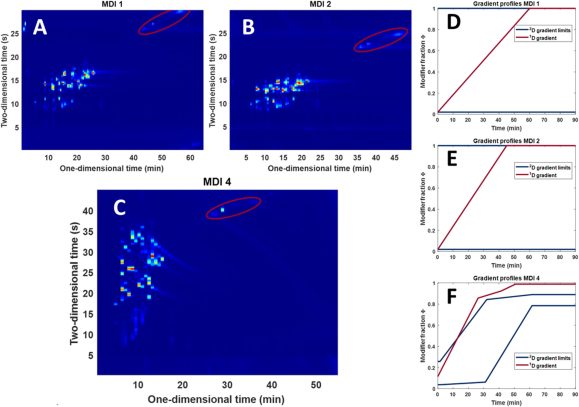
In their latest work, the AutoLC team of the CAST group of Pirok at the University of Amsterdam extended their method-development workflow to facilitate optimisation of 2D-LC separations [1].

The demonstrated workflow was capable of unsupervised gradient optimization for comprehensive 2D-LC-MS methods without needing to specify sample information. The required algorithms were designed by CAST researchers Stef Molenaar, Tijmen Bos and Jim Boelrijk, under the supervision of Bob Pirok.

The workflow was inspired by the original theoretical paper by Pirok in 2016 [2], in which retention models are constructed to computationally simulate methods and select the optimal parameters. In a nutshell, the system first utilizes very generic methods to measure the sample. This data is then used to construct retention models that describe the retention behavior of the analytes as a function of the mobile-phase composition. A large number of methods are then simulated computationally, and a computed optimum is submitted to the LC system. The LC system then carries out the proposed method and submits its data back to the system afterwards. Consequently, unsupervised optimisation of 2D-LC separations may be attained.

Unsupervised optimization of comprehensive 2D-LC separations
Figure 1. The AutoLC algorithm was demonstrated on a peptide digest separation using RPLC in both dimensions. Panels A, B, D and E show scanning conditions, with Panels C and F showing a computed method that was proposed unsupervised by the algorithm. Reproduced with permission from [1].

The Pirok group earlier had demonstrated their AutoLC platform on 1D separations [3], but now extended this to the more complicated 2D separation methods [1]. To accomplish this, algorithms were designed to compute and optimize complex second-dimension shifted-gradient assemblies.

The researchers also investigated the robustness of the retention models and the influence of the errors in peak-width predictions.

The study was conducted in a collaboration with the group of Dwight Stoll at Gustavus Adolphus College where the measurements were conducted. The developed tool for optimisation of 2D-LC separations was demonstrated on a complex peptide digest sample with RPLC in both of the dimensions.

The work was a product of Pirok’s UPSTAIRS (Unleashing the Potential of Separation Technology to Achieve Innovation in Research and Society) project, which is financed by the Dutch Research Council (NWO), as well as the synergetic UNMATCHED project, which is supported by BASF, DSM and Nouryon, and also receives funding from NWO.

The work was published open-access in Journal of Chromatography A and can be accessed free of charge here.

References

  1. Computer-driven optimization of complex gradients in comprehensive two-dimensional liquid chromatography, S.R.A. Molenaar, T.S. Bos, J. Boelrijk, T.A. Dahlseid, D.R. Stoll, B.W.J. Pirok, Chromatogr. A, 2023, 1707, 464396, DOI: 10.1016/j.chroma.2023.464306.
  2. Program for the interpretive optimization of two-dimensional resolution, B.W.J. Pirok, S. Pous-Torres, C. Ortiz-Bolsico, G. Vivó-Truyols and P.J. Schoenmakers, J. Chromatogr. A, 2016, 1450, 29–37, DOI: 10.1016/j.chroma.2016.04.061.
  3. Chemometric Strategies for Fully Automated Interpretive Method Development in Liquid Chromatography S. Bos, J. Boelrijk, S.R.A. Molenaar, B. van ‘t Veer, L.E. Niezen, D. van Herwerden, S. Samanipour, D.R. Stoll, P. Forré, B. Ensing, G.W. Somsen, B.W.J. Pirok, Anal. Chem. 2022, 94(46), 16060–16068, DOI: 10.1021/acs.analchem.2c03160.
Categories
Publications

2D-LC in industry: technological innovations reviewed

CAST scientist Rick van den Hurk wrote a review on recent developments in 2D-LC and the use of 2D-LC in industry. He did this under the supervision of Bob Pirok and in collaboration with Matthias Pursh (Dow) and Dwight Stoll (Gustavus Adolphus College).

Two-dimensional liquid chromatography (2D-LC) greatly advances the separation powered of analytical separation sciences through a better peak capacity as well as offering more-tailored selectivity combinations.

However, the field of 2D-LC is, in particular in contrast to 2D-GC, still very immature and under significant development. In 2019, Bob Pirok, Dwight Stoll and Peter Schoenmakers published a review in which they examined the latest trends from 2015 until 2019 [1].

In this recent installment [2], Rick van den Hurk reviewed the recent innovations between 2019 and 2023. In addition the review also devotes significant focus to the implementation of the technique in industry. The review was co-written by Bob Pirok, Dwight Stoll (Gustavus Adolphus College) and Matthias Pursch (Dow).

The authors examined over 200 articles and also compared these with the articles published prior to 2019. In their review, the authors concluded that mobile-phase mismatch continues to be an important focus area for the field, and several modulation strategies and new variants were discussed.

Van den Hurk and co-workers also noticed that a third of the publications had at least one author affiliated with industry. Application fields that particularly demonstrated involvement were the polymer characterization, metabolomics, and pharmaceutical and biopharmaceutical analysis. Furthermore, industrial applications favored the use of heart-cut 2D-LC and largely employed on-line hyphenation. The authors did note that the database was likely to be missing out on a number of industrial works that are not published for confidentiality reasons.

Other important developments were the increased popularity of computer-aided strategies, alternative gradient-elution methods to facilitate modulation, as well as multi-stage, multi-dimensional separations, the latter of which were applied to the characterization of protein therapeutics.

2D-LC in industry: technological innovations reviewed
Figure. Number of applications per application area distributed by non-comprehensive (light blue) and comprehensive (dark blue) applications between 2019 and 2023. Reproduced with permission from [2].

Two-dimensional liquid chromatography is of paramount importance to the PARADISE project of CAST scientist Bob Pirok in which multi-dimensional separation technology is used to achieve separation of highly complex samples. In addition, the project aims to characterize the correlation of different sample properties within a single analytical solution. The outcomes of this recent review are thus of value to the ongoing progress in the PARADISE project. Rick van den Hurk is a PhD candidate in the PARADISE project, which stands for Propelling Analysts by Removing Analytical-, Data-, Instrument- and Sample-related Encumbrances and receives funding from the Dutch Research Council (NWO), as well as a number of public and private organisations. Read more about the PARADISE project here.

In addition, the review was part of Pirok’s UPSTAIRS project, which aims to improve the accessibility of advanced separation technology by developing computational methods to leverage chromatographic theory in an unsupervised workflow. This project also receives funding from NWO.

The work was published in TrAC Trends in Analytical Chemistry as open access, and can thus be accessed for free here.

References

  1. Recent Developments in Two-Dimensional Liquid Chromatography: Fundamental Improvements for Practical Applications, B.W.J. Pirok, D.R. Stoll and P.J. Schoenmakers, Anal. Chem., 2019, 91(1), 240-263, DOI: 10.1021/acs.analchem.8b04841
  2. Recent trends in two-dimensional liquid chromatography, R.S. van den Hurk, M. Pursch, D.R. Stoll, B.W.J. Pirok, TrAC Trends in Analytical Chemistry, 2023, 166, 117166, DOI: 1016/j.trac.2023.117166
Categories
Publications

Latest developments in 2D gas chromatography reviewed

Comprehensive two-dimensional GC (GC×GC) has developed significantly in the three decades since the technique was first demonstrated experimentally. Consequently, the number of users, published methods, and scientific papers about 2D GC has increased dramatically. In their recent review in Journal of Separation Sciences, CAST member Nino Milani along with Eric van Gilst discuss the latest developments in 2D gas chromatography [1]. The authors reviewed the latest developments in modulation methods and also touched upon detection, retention modelling and data analysis.

Interestingly, Milani et al. found a surprising large number of technology-oriented publications that investigated new modulation technology. Thermal modulators – which are mostly used in application-papers still – yield excellent performance, even without the need for coolant consumables. Novel flow modulators can compete with thermal modulators, yet tend to be simpler and easier to operate.

The authors found a discrepancy between the use of flow modulation in technology-driven publications versus those in application studies. This was considered a testimony to the fact that the field is still highly dynamic, despite the widely-perceived maturity of GC×GC.

Milani also concluded that benchmark datasets were required to properly evaluate the latest developments in the field of signal processing and data analysis.

GC×GC is, along with GC×GC, of high interest to the PARADISE project, in which 2D chromatography is used to establish simultaneous determination and correlation of multiple sample dimensions. The analysis of datasets originating from 2D separations is also of high interest. Therefore, this review on the latest developments in 2D gas chromatography was written in the context of the PARADISE project. The PARADISE project is funded by public and private organisations and also receives funding from the Dutch Research Council (NWO).

The review was published open access in Journal of Separation Science and can be accessed free of charge here.

References

[1] Comprehensive twodimensional gas chromatography—A discussion on recent innovations, N.B.L. Milani, E. van Gilst, B.W.J. Pirok, P.J. Schoenmakers, J. Sep. Sci., 2023, DOI: 10.1002/jssc.202300304

Categories
Publications

Peak tracking for larger numbers of 2D chromatography datasets

In an international collaboration with the University of Stellenbosch, Gustavus Adolphus College and Envalior, a peak-tracking algorithm was developed by CAST scientist Stef Molenaar to compare multiple datasets in one-dimensional (1D) and two-dimensional (2D) chromatography [1]. In his study, Molenaar investigated two application strategies: i) data processing where all chromatograms are produced in one sequence and processed simultaneously, and ii) method optimization where chromatograms are produced and processed cumulatively. The latter strategy is analogue to practice in within the AutoLC framework that is developed by the Pirok group.

Peak tracking for 2D chromatography
Structure of a comprehensive 2D chromatogram. A) raw data, B) folded data matrix, C) interpolated matrix, D) reconstructed first dimension chromatography, E) reconstructed second dimension chromatogram. Reproduced with permission from [2].

One of the difficult operations in using comprehensive 2D chromatography concerns the data processing. With the first dimension not having its own detector, the first-dimension chromatogram must be reconstructed using the information obtained from the second-dimension detector (Figure 1A). This process is also referred to as “folding of the chromatogram”. The result is what is shown in Figure 1B.

As a result, the number of datapoints in the first dimension is equal to the number of modulations. There thus exists a scarcity of data to reconstruct the first dimension (Figure 1D), relative to the abundance of datapoints to describe the second dimension (Figure 1E).

Linking strategies for peak tracking for 2D chromatography
Different clustering strategies. Chromatogram #3 (red) represents a dataset where something went wrong, and thus connections with chromatogram #3 don't provide information about at least one peak. However, following other connections still creates an intact network (green). A) Batch strategy: Each chromatogram is connected to the next, creating a loop indicated with the black dotted line, and then random cross connections are made within the loop. B) Complete strategy: All chromatograms are connected to all others. C) Cumulative strategy: Every new chromatogram is connected to two randomly selected chromatograms. Reproduced with permission from [1].

In his article, Molenaar tested the first strategy on data from comprehensive 2D liquid chromatography (LC×LC) and comprehensive 2D gas chromatography (GC×GC) separations of academic and industrial samples of varying compound classes (monoclonal-antibody digest, wine volatiles, polymer granulate headspace, and mayonnaise). To accomplish this, he collaborated with scientists Dr. John Mommers (Envalior), Prof. Dwight Stoll (Gustavus Adolphus College), Sithandile Ngxangxa (University of Stellenbosch) and Prof. André de Villiers (University of Stellenbosch).

The work is envisaged to be instrumental for successful translation of the AutoLC algorithm [3] to 2D separations. The study was part of the UPSTAIRS project of Pirok and funded by the Dutch Research Council (NWO).

The study was recently published in Journal of Chromatography A and can be accessed freely here.

References

  1. Algorithm for tracking peaks amongst numerous datasets in comprehensive two-dimensional chromatography to enhance data analysis and interpretation, S.R.A. Molenaar, J.H.M. Mommers, D.R. Stoll, S. Ngxangxa, A.J. de Villiers, P.J. Schoenmakers, B.W.J. Pirok, Chromatogr. A, 1705, 2023, 464223: DOI: 10.1016/j.chroma.2023.464223.
  2. Challenges in Obtaining Relevant Information from One- and Two-Dimensional LC Experiments, B.W.J. Pirok & J.A. Westerhuis, LC-GC North America, 6(38), 2020, 8-14, DOI: 10.56530/lcgc.na.jk4782s5.
  3. Chemometric Strategies for Fully Automated Interpretive Method Development in Liquid Chromatography S. Bos, J. Boelrijk, S.R.A. Molenaar, B. van ‘t Veer, L.E. Niezen, D. van Herwerden, S. Samanipour, D.R. Stoll, P. Forré, B. Ensing, G.W. Somsen, B.W.J. Pirok, Anal. Chem. 2022, 94(46), 16060–16068, DOI: 10.1021/acs.analchem.2c03160.